Simple Home Organization Hacks for Closets and Sock Drawers
8 min read ·
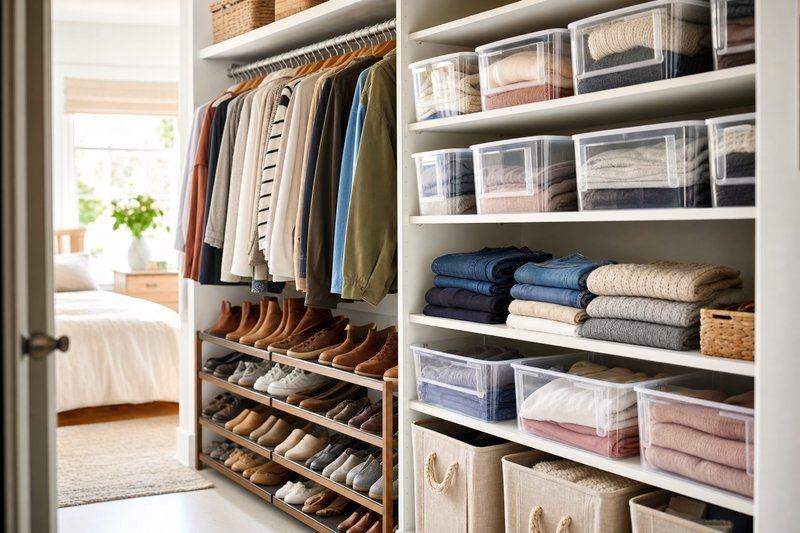
Some of the messiest spots in a house aren’t big rooms, they’re small, specific zones that quietly fill up with clutter: a closet floor, the dead space under a bed, or a sock drawer that never quite matches up. These home organization hacks tackle all three with cheap, simple solutions, no expensive storage-system overhaul required.
Closet Organization: Getting Control of the Floor and Shelves
A closet floor tends to become a catch-all for shoes, bags, and anything that doesn’t have another home, which is usually a sign the closet needs zones. More shelves won’t fix it. Assigning one specific area for shoes (a shoe rack or simple shelf divider), one for bags, and one for anything seasonal keeps items from spreading across the whole floor. Vertical space above the hanging rod is one of the most underused areas in a typical closet; a slim set of stacked bins there holds off-season items without competing with everyday clothing storage.
Hanging organizers with multiple pockets or cubbies, mounted on the back of the closet door, add storage without taking up any floor or shelf space at all, and work well for smaller items like scarves, belts, or folded accessories that otherwise end up in a loose pile.

Under-Bed Storage: Using the Most Overlooked Space in a Room
The space under a bed is one of the largest unused storage areas in most bedrooms, and flat storage bins (with or without wheels) make it genuinely usable. Without them it becomes a place where loose items get shoved and forgotten. Clear bins beat solid-colored ones here, since they make it easier to find a specific item without pulling every bin out first. For anyone without a bed frame with enough clearance, risers (small blocks that lift the bed frame a few extra inches) create just enough space for a slim bin where there wasn’t room before.
Under-bed storage works especially well for off-season clothing, spare bedding, or wrapping paper and gift supplies, since these are all items that need to be accessible a few times a year but don’t need to sit in daily view.
Sock Drawer Organization: Solving the Matching Problem
A messy sock drawer is less about not having enough space and more about not having any internal structure, which is why a drawer divider or a set of small fabric bins inside the drawer makes such a visible difference. Sorting by category (ankle socks, dress socks, athletic socks) means a matching pair is easy to find without digging.
For anyone who consistently loses sock matches in the wash, a small mesh laundry bag dedicated just to socks keeps pairs together from hamper to dryer, cutting down on the single-sock pile that tends to build up in the back of a drawer over time.

Budget Tools That Cover All Three Spots
None of these three areas need an expensive storage-system purchase. A handful of clear plastic bins, a couple of drawer dividers, an over-the-door pocket organizer, and a set of stackable shelf risers cover the closet, under-bed, and sock-drawer projects together for a modest total cost, and most of these items are reusable if priorities or room layouts change later.
Maintaining an Organized System Once It’s Set Up
The initial setup is usually the easy part; keeping a system working long-term comes down to a quick, regular reset. A one-time perfect sort won’t hold. A five-minute pass through the closet floor or sock drawer every week or two, putting anything that’s drifted out of its zone back where it belongs, prevents the slow slide back into clutter that a single big organizing session alone won’t stop.
Adapting These Hacks for Kids’ Rooms
The same three zones (closet, under-bed, and drawer organization) work just as well in a kids’ room, often with slightly larger bins and lower-mounted door organizers so kids can reach and use the system themselves. Involving kids in choosing which bin holds what tends to make an organizing system stick better since they have some ownership over where things go.
Labeling Systems That Keep Zones Working Long-Term
A zone-based system (for a closet, under-bed bins, or a divided sock drawer) only stays useful if it’s obvious at a glance what belongs where, which is where labeling earns its keep. Simple adhesive labels on bin lids, or a small tag tied to a hanging organizer’s pocket, remove the guesswork that otherwise leads to items getting shoved into whatever spot is closest. For households with more than one person using the same storage area, a labeled system also cuts down on items ending up in the wrong place simply because someone else wasn’t sure where something belonged.
Adjusting These Systems as Needs Change
A closet, under-bed, or drawer system that worked well a year ago may not fit current needs if a wardrobe, family size, or living situation has changed since then. Revisiting the zones every six months or so, on the assumption that no first setup is permanent, catches the moment a bin is consistently overflowing or a zone has sat mostly empty, both signs that the original layout needs a small adjustment well short of a full redo.
Renter-Friendly Versions of These Same Hacks
None of these three projects require drilling, permanent shelving, or anything a landlord would object to, which makes them worth knowing for renters as much as homeowners. Over-the-door organizers hang on the door itself, closet risers and bins sit freestanding, unmounted, and drawer dividers fit inside an existing dresser without any hardware at all. For a closet with a single flimsy wire shelf and nothing else, a freestanding shelf unit that simply sits on the floor adds real storage without touching the walls, and moves out just as easily as it moved in when a lease ends.
Choosing Bin Sizes and Materials
Bin size matters more than it first seems: an oversized bin under a bed or on a closet shelf tempts overfilling, which makes it heavy and awkward to pull out, while several smaller bins sorted by category stay lighter and easier to access individually. Clear plastic is the most practical material for see-through contents, but a woven or fabric bin works just as well for anything already sorted by drawer or shelf position, where visibility matters less than a softer, less utilitarian look on open shelving. Stackable bins that share one footprint, with no mismatched assortment of shapes, make far better use of vertical space in a closet or under a bed, since uniform bins nest and stack without wasted gaps between them.
Common Organization Mistakes That Undo Progress Fast
A few habits quietly undo an otherwise solid organizing system faster than anything else. Buying bins before measuring the actual space is one of the most common: a bin that’s an inch too tall for a shelf or too wide for the space under a bed ends up sitting sideways or half-used, which defeats its purpose. Over-sorting into too many tiny categories is another; a sock drawer split into six narrow compartments instead of three broader ones (ankle, dress, athletic) often ends up harder to use day to day than a simpler system, since every item now has to fit one very specific slot. And leaving a system fully unlabeled, even when it seems obvious to the person who set it up, is a common reason a shared closet or drawer slides back into a jumble within a few weeks, since anyone else using the space has no way to guess where things belong.