Easy DIY Road Trip Games for Kids That Cost Almost Nothing to Make
7 min read ·
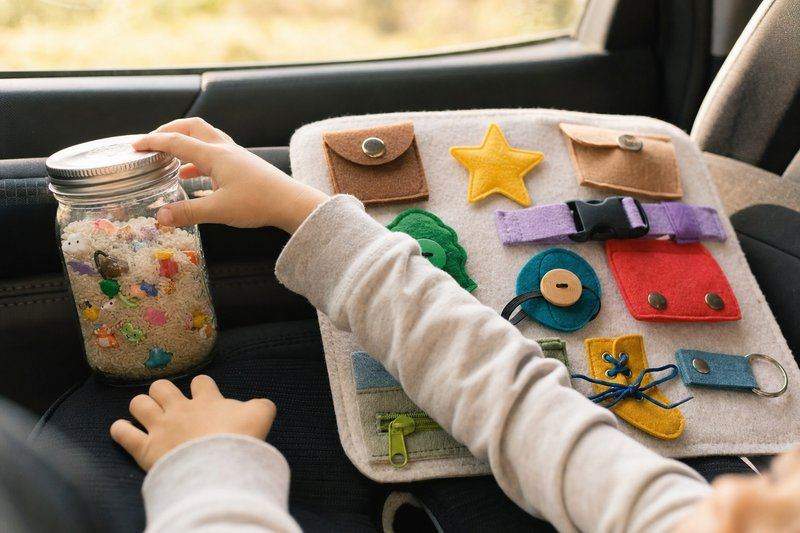
Store-bought travel games solve one trip and then usually get left in a drawer, while a budget homemade version can be built around exactly what your kids already like and restocked or refreshed for the next trip. These DIY road trip games are all built from cheap, easy-to-find materials, and every one of them packs down small enough for a car door pocket or a glovebox.
Why Homemade Travel Games Work Well in the Car
A homemade game can be sized exactly to the trip and the kid: a busy board with only the fasteners a toddler is currently working on, or an I-spy jar filled with objects pulled straight from around the house. That kind of customization is hard to get from a boxed game, and it’s a big part of why these DIY road trip games tend to hold attention longer than a generic store-bought option.
Felt Busy Board (Ages 2-5)
What you need: a piece of sturdy felt or foam board, fabric scraps, buttons, zippers, buckles, and a hot glue gun or needle and thread.
- Cut the felt or foam board to a size that fits flat on a car seat tray or a young rider’s lap, roughly 10 by 12 inches.
- Glue or stitch a variety of fasteners onto the board in a grid: a zipper, a buckle, a few large buttons through fabric loops, a snap, and a lace-up section made from two fabric flaps and a shoelace.
- Space each fastener far enough apart that small hands can work one at a time without accidentally bumping into the next.
This kind of hands-on busy board keeps younger kids occupied through fine-motor practice, and it packs completely flat for storage between trips.

I-Spy Jar (Ages 4 and Up)
What you need: a clear plastic jar or bottle, rice or small dried beans to fill it, and 15-20 small household objects (buttons, beads, a small toy figure, a paperclip).
- Fill the jar about two-thirds full with rice or dried beans.
- Drop in the small objects one at a time, shaking gently between each addition so they distribute through the rice instead of sitting in a visible layer on top.
- Seal the lid securely, with tape or hot glue around the rim for extra security in a moving car.
- Write or print a simple list of the hidden objects to tape onto the jar, so kids know exactly what they’re hunting for as they shake and search.
An I-spy jar is one of the quietest travel games to make, since it needs no cutting or sewing at all, just careful layering.

Felt Storyboard (Ages 3-7)
What you need: a piece of felt for the background, several smaller felt shapes cut into simple scenes (a house, trees, animals, vehicles), and a small drawstring bag for storage.
- Cut a background piece of felt, big enough to lay flat on a lap tray.
- Cut simple shapes from contrasting felt colors: houses, trees, cars, animals, whatever fits a story a child likes to retell.
- Felt naturally sticks to itself with light pressure, so no glue or velcro is needed for pieces to stay in place on the background as a story is built and rearranged.
- Store all the pieces in a small drawstring bag or a zip pouch alongside the folded background.
This one doubles as quiet independent play or a shared activity where an adult and child take turns adding to the same scene.
License Plate Word Game (Ages 6 and Up)
What you need: nothing but paper and a pencil, or a small dry-erase board for reuse.
- As passing cars are spotted, write down the three letters from each license plate.
- The challenge is coming up with a word or short phrase where those three letters appear in order, even if other letters are added in between.
- Keep a running tally of points, with longer or more creative phrases worth more.
This is the simplest game on the list to prep, since it needs no materials beyond something to write with, and it works equally well for a car full of kids or as a one-on-one game with a single rider.
Choosing Games Based on Trip Length
A short trip under an hour usually only needs one or two games, and the license plate word game or a quick I-spy jar covers that well without much prep. Longer trips benefit from rotating between two or three different games, with no single one carrying the trip, since attention for any single activity tends to fade after 30-45 minutes in a moving car. For an especially long trip, packing one quiet independent activity (like the felt storyboard) alongside one that works better as a group activity (like the license plate game) covers both solo downtime and shared engagement across a full day of driving.
Involving Kids in Making Their Own Game
Older kids, especially those in the 7-and-up range for the felt storyboard or busy board, often enjoy helping design their own version, and not just receiving a finished one. Letting a child pick which fasteners go on a busy board, or which small objects go into an I-spy jar, adds a sense of ownership that tends to make the finished game hold more of their interest once it’s actually in the car. It also turns the craft project itself into a pre-trip activity, which can help with the anticipation and excitement of an upcoming trip.
Rotating Games to Keep Interest Fresh on Long Trips
Bringing out all the games at once at the start of a trip tends to burn through their novelty faster than spacing them out. Holding one or two games back and introducing them a couple of hours in, framed as a “new” activity, tends to hold attention better on longer drives. The I-spy jar in particular works well saved for later in a trip, since restocking it with a few different small objects partway through effectively turns it into a second, fresh game with the same simple base.
Packing Tips for Keeping Pieces Contained
Small zip pouches or reused snack bags keep loose game pieces from scattering across the back seat. A shoebox or small plastic bin, one per game, works well for anything bulkier like a felt storyboard’s full piece set. Labeling each container clearly means a game can be handed straight to a kid at the start of a trip without a parent needing to dig through a bag mid-drive.
Car Snacks Worth Packing Alongside the Games
Games buy attention, but a road trip still runs on snacks, and the same rules that make a game work in a moving car apply here: no big crumbs, nothing that needs both hands, and nothing that melts on a warm dashboard. Pre-portioned bags of pretzels, crackers, or trail mix beat a single shared bag, since each rider gets their own supply without passing anything across the back seat. Dried fruit, apple slices tossed with a little lemon juice to keep them from browning, and cheese cut into small cubes travel well without refrigeration for a few hours. A muffin tin or a divided container turns a mix of two or three snacks into a car-safe version of a snack board, so a game like the I-spy jar can sit in one hand while the other reaches for a pre-portioned cup instead of digging through a loose bag.
Keeping It Budget-Friendly
None of the five games above need a shopping trip specifically for the project. Felt scraps, buttons, a spare jar, and paper are common household items, which keeps the whole batch of games budget-friendly even if you’re making all five at once for a single trip.